
If you have ever walked past a busy teer counter in Shillong or Khanapara and wondered how much a ticket costs, you are asking the most practical question about the game. The teer ticket price is refreshingly simple. Tickets are sold in small fixed denominations, the price is the same at every licensed counter, and there are no hidden charges, no taxes and no bargaining. You pick a number from 00 to 99, pay the printed denomination, and receive a printed slip that is your proof of purchase.
This guide explains the full picture around the teer ticket price in plain terms. You will learn the standard denominations, how tickets differ between the first round and second round, how the price connects to prize payouts, where legitimate counters operate, what the sale timings look like, and why you should never buy a ticket online. Teer is a legal lottery in Meghalaya for adults aged 18 and above, organised under the state lottery framework, and like any game of chance it should be played with a fixed budget and a responsible mindset.

What the Teer Ticket Price Covers
The teer ticket price is simply the amount printed on your ticket that you hand over at the counter. Unlike some games where fees or commissions are added on top, teer pricing is flat. A Rs 10 ticket costs Rs 10, a Rs 50 ticket costs Rs 50, and the seller prints your slip as soon as you pay. This simplicity is one reason the game is trusted by regular players across Meghalaya: the transaction is transparent and takes less than a minute.
It helps to think of the ticket price as two things at once. First, it is your cost of participation, the small amount you spend for the chance to take part in a round. Second, it is your stake, because the prize you can win is calculated as a multiple of this amount. A higher denomination does not change your odds of winning in any way. The number you choose has exactly the same chance whether it sits on a Rs 1 ticket or a Rs 50 ticket. The only difference is the size of the payout if your number is declared.
For a newcomer, the practical takeaway is to start with the smallest denominations. The game runs every working day, so there is no rush to spend more on day one. Learn how the rounds work, get comfortable checking results, and keep your spending within a weekly entertainment budget you set in advance.
Standard Teer Ticket Denominations
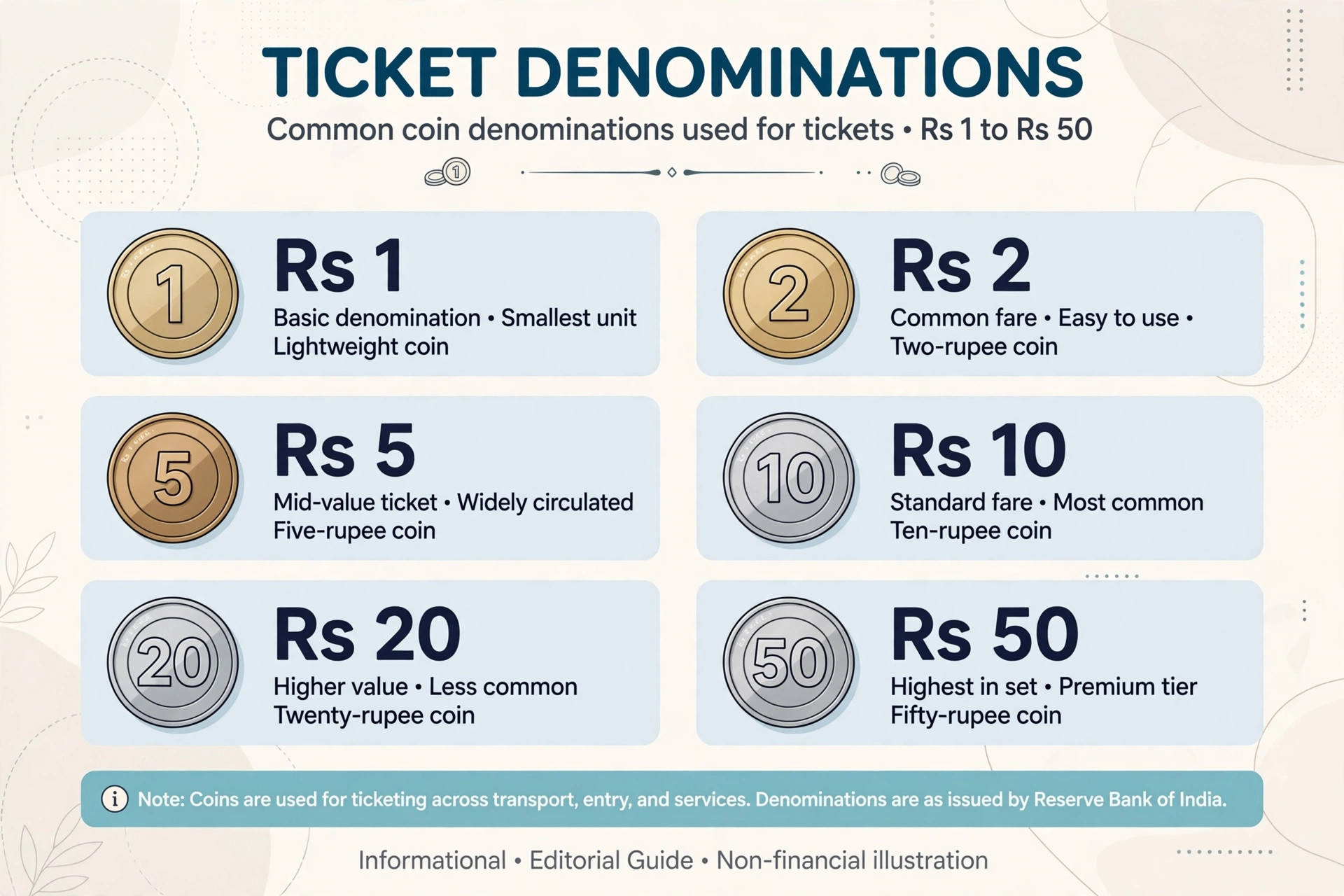
At licensed counters, teer tickets are sold in fixed denominations of Rs 1, Rs 5, Rs 10, Rs 20 and Rs 50. These are the recognised price points for the game, and they apply uniformly across Shillong, Juwai, Khanapara and the other teer markets. If a seller quotes any price outside these denominations, that is a red flag that the counter may not be operating legitimately.
The Rs 10 ticket is by far the most common choice among regular players. It strikes a practical balance: the cost is negligible, yet the payout multiple makes a win meaningful. Players who want a bigger stake on a particular number typically buy a Rs 20 or Rs 50 ticket, while the Rs 1 and Rs 5 denominations are used by those who play purely for fun or who spread several small guesses across different numbers.
One important habit is to confirm the denomination printed on your slip before leaving the counter. The slip should show your chosen number, the round or rounds it covers, the price paid and a serial reference. These four details together make a valid ticket. A quick glance at the counter takes two seconds and prevents the rare but real mistake of a misprinted denomination.
How Teer Ticket Price Works for FR and SR Rounds
Every teer session is conducted in two rounds, known as the first round (FR) and the second round (SR). When you buy a ticket, you are buying entry into one or both of these rounds, and the teer ticket price applies to whichever coverage you choose. If you buy a Rs 10 ticket for the first round only, it is checked against the first round declared number. If you want both rounds, you either buy two tickets or ask for a both-rounds ticket, paying the denomination for each round covered.
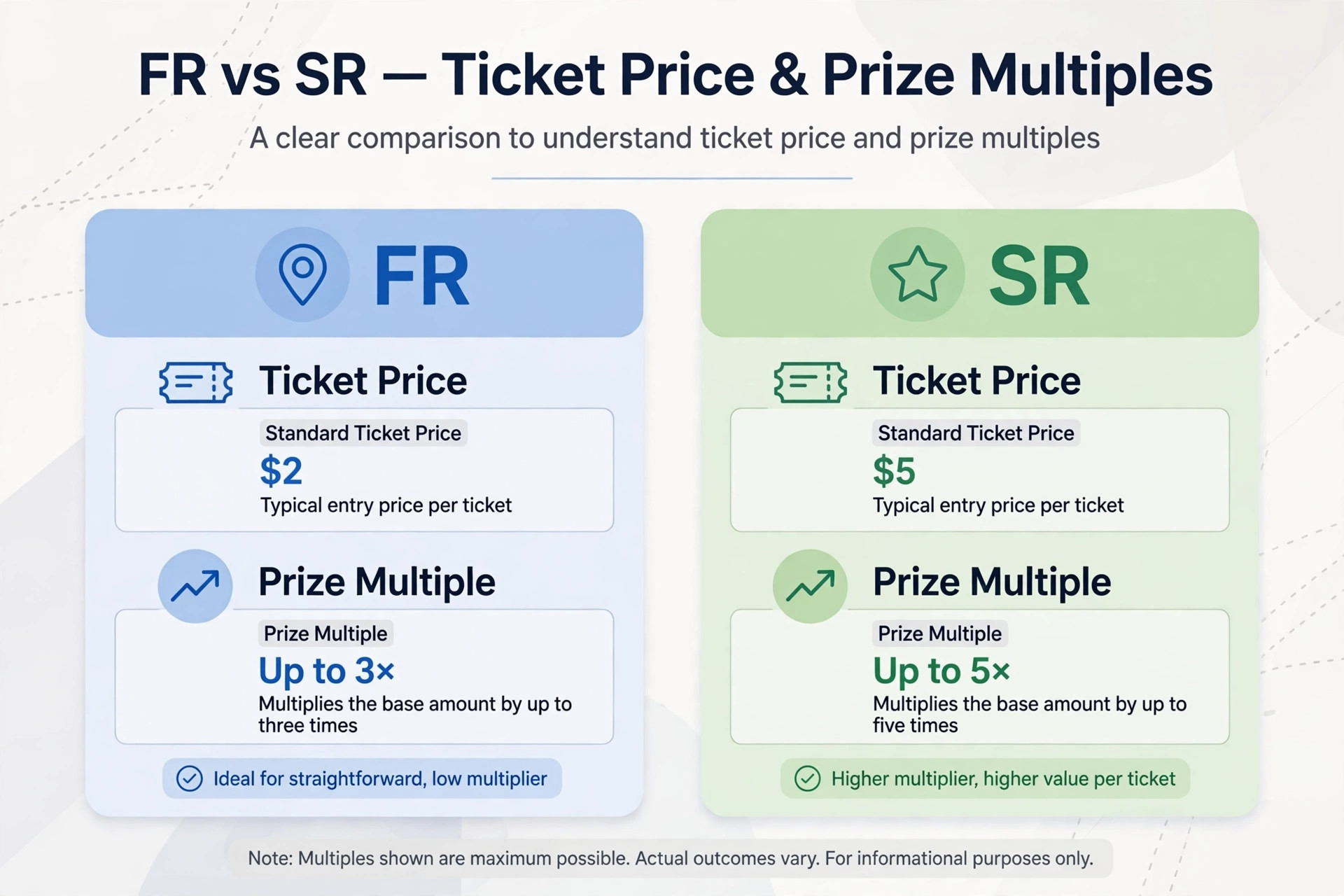
This is where the price connects directly to prizes. The payout structure of teer is built on fixed multiples of the staked amount: a correct guess in the first round pays roughly 80 times the bet, while a correct guess in the second round pays roughly 60 times the bet. To put that in concrete terms, a Rs 10 stake on the first round that matches the declared number returns around Rs 800, and the same Rs 10 stake on the second round returns around Rs 600. A Rs 50 ticket multiplies these figures accordingly, which is why higher denominations exist.
Notice what does not change with price: the probability. Every two-digit number from 00 to 99 has the same chance in each round, regardless of the denomination on the slip. Paying more never buys a better chance, only a bigger potential return. Keep this firmly in mind whenever you are tempted to increase your stake, because it is the single most misunderstood fact about the teer ticket price.
After each round is conducted, you can check the declared numbers for both rounds on the View Teer Result homepage, which publishes daily updates for every market.
Finding a Teer Counter Near You
A teer counter is a small licensed shop or kiosk authorised to sell tickets, and it is the only legitimate place to buy one. In Shillong, counters are spread across busy localities including the Polo area, Laitumkhrah and the main market neighbourhoods, usually marked by clear teer signage. Juwai has its own network of counters serving the local game, and Khanapara counters cater to players in the Guwahati border region. Night session counters operate in the evening in the same areas, following the same licensing rules.
How to Identify a Licensed Shillong Teer Counter
Recognising a genuine shillong teer counter is easier than it sounds. Look for fixed signage displaying the teer name, a proper shop structure with a visible selling area, and tickets issued as printed slips from a machine or register. Licensed sellers operate openly during sale hours and never rush you or demand unusual payment methods. If you are unsure, ask a nearby shopkeeper or a local resident to point you to the recognised counter in the area; communities around the game know exactly which counters are legitimate.
What to Watch Out for at Unlicensed Sellers
Street vendors with no fixed counter, sellers offering handwritten slips, and anyone willing to sell tickets after the official sale cutoff should be avoided completely. Equally suspicious is any seller who quotes a teer ticket price outside the standard denominations or who asks for payment through a personal mobile wallet to a private number. Genuine counters have nothing to hide and no reason to deviate from the standard system.
Buying a Teer Ticket at the Counter, Step by Step
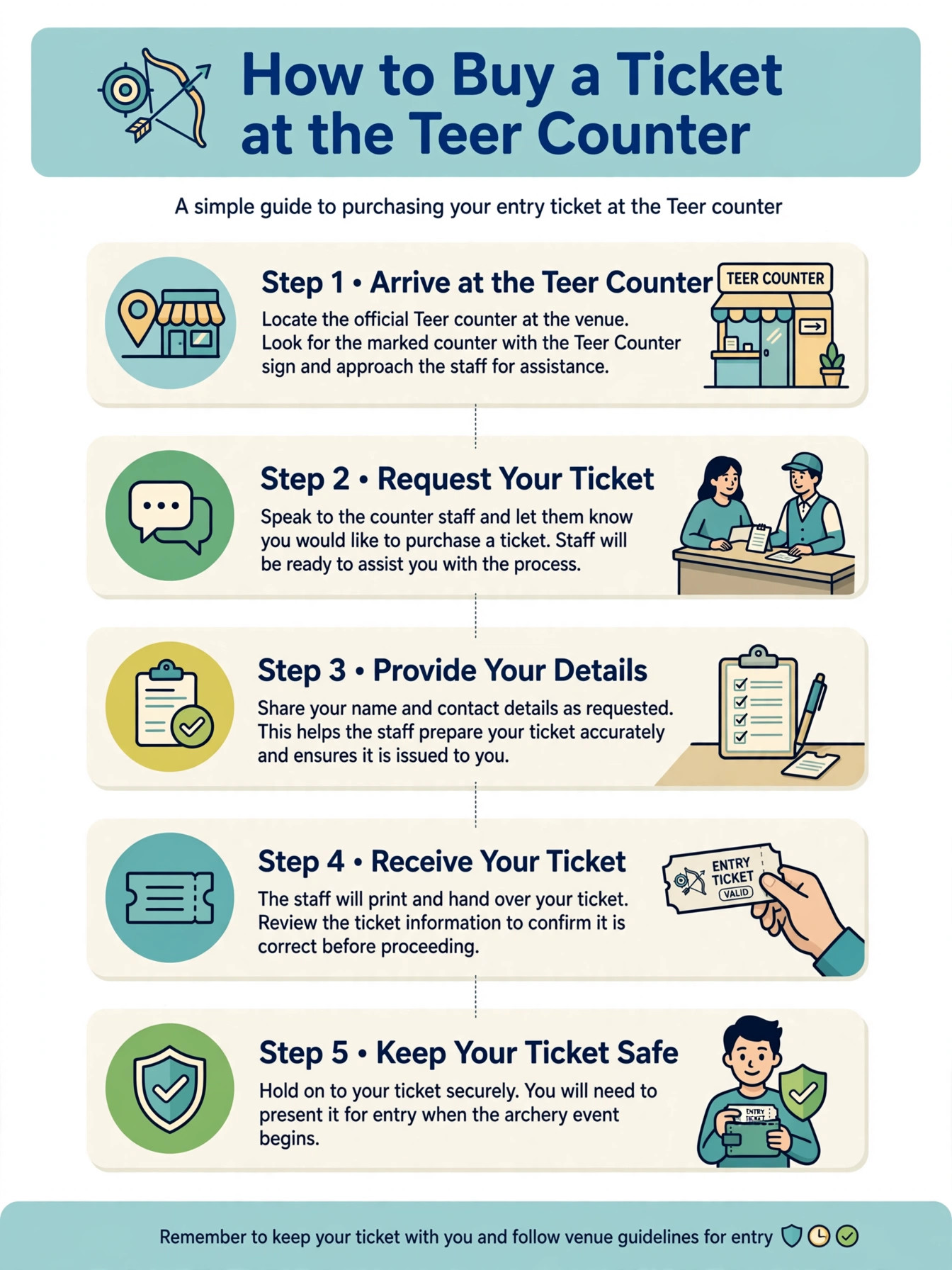
The purchase process is quick and follows the same pattern everywhere. Here is exactly what happens when you walk up to a teer counter.
First, choose your number. Pick any two digits from 00 to 99. Regular players use their own methods for choosing, and newcomers often pick a meaningful date or simply a number they like. Every number carries the same chance, so there is no strategic advantage in any particular choice.
Second, state the round. Tell the seller whether you want the first round, the second round or both. If you are buying for the first time, starting with the first round only keeps things simple. You can always purchase a second round ticket separately afterwards.
Third, name the denomination. Say the teer ticket price you want, for example Rs 10 or Rs 20, and pay the exact amount. Keep small change ready if you can, because counters handle heavy footfall near closing time and exact payment speeds up the queue for everyone.
Fourth, verify the printed slip. Before stepping away, read your ticket and confirm the number, the round coverage, the denomination and the serial reference. The seller corrects genuine mistakes on the spot, but only if you catch them at the counter. Then keep the slip somewhere safe and dry until the results are declared. Thermal printed slips fade in sunlight or when washed in a pocket, so a wallet or envelope is the right place for them.
Teer Ticket Price and Prize Payouts in Detail
Understanding the relationship between what you pay and what you can win helps you play with realistic expectations. As noted earlier, the game uses fixed payout multiples: roughly 80 times the stake for a correct first round guess and roughly 60 times for a correct second round guess. These multiples apply to the teer ticket price of the individual ticket, not to any total you might spend across several tickets.
Here is how the arithmetic looks for the standard denominations, so you can see why the Rs 10 ticket is so popular:
- Rs 1 ticket: around Rs 80 on a first round win, around Rs 60 on a second round win
- Rs 5 ticket: around Rs 400 on a first round win, around Rs 300 on a second round win
- Rs 10 ticket: around Rs 800 on a first round win, around Rs 600 on a second round win
- Rs 20 ticket: around Rs 1,600 on a first round win, around Rs 1,200 on a second round win
- Rs 50 ticket: around Rs 4,000 on a first round win, around Rs 3,000 on a second round win
These figures are approximate and can vary slightly between organisers, so treat them as a guide rather than a guarantee. The key principle is proportionality: doubling your ticket price doubles the potential prize but also doubles what you lose when the number does not come up. Since the odds are identical for every denomination, the rational approach is to choose a stake you are comfortable losing in full, every single time you play.
Prize claims require the original printed ticket. Winners present the slip at the counter within the claim window set by the organiser, and the prize is paid against verification of the serial reference. This is another reason the physical ticket matters so much: without it, there is no claim, no matter how certain you are of your number.
Can You Buy a Teer Ticket Online?
This question comes up constantly, and the answer needs to be stated without any ambiguity: there is no legal or official way to buy a teer ticket online. The organisers have never authorised internet sales, mobile applications, social media agents or booking through messaging platforms. Every single offer of teer tickets over the internet is a scam, without exception.
The scams follow predictable patterns. A seller on a messaging app asks for payment through a digital wallet and sends back a fake confirmation image that has no validity. More elaborate fraudsters declare your number a winner and then demand a release fee or tax payment before releasing a prize that does not exist. Because no genuine online ticket exists, victims have no valid claim and almost no way to recover the money.
This matters for the teer ticket price discussion because scammers frequently invent attractive fake prices: discounted bulk tickets, special online rates, or premium VIP tickets. Real prices are fixed, public and printed on the slip. If anyone offers you a deal that differs from the standard denominations, or any way to buy without visiting a counter in person, walk away immediately. Genuine participation means a printed ticket from a licensed teer counter, bought in person, during sale hours. Nothing else counts.
For reliable background on how lotteries are structured and regulated in India, the Teer article on Wikipedia is a solid starting point, and official state information is available through the Meghalaya government portal.
Teer Counter Sale Timings and Ticket Price Windows
Ticket sales follow the rhythm of the game sessions. Teer runs in several sessions through the day: morning games, the main day game and night games, each with its own first round and second round. The teer ticket price stays identical across all sessions, but tickets are session specific. A ticket bought for the morning session is valid only for the morning rounds. If you want to play the day session as well, you buy a separate ticket during the day sale window.
Counters generally open in the morning and sell tickets continuously until shortly before each round begins. Once the sale cutoff passes for a round, no genuine ticket for that round can be created, and sales pause while the round is conducted. Anyone offering to arrange a ticket after the cutoff is attempting fraud. The safest habit is to arrive at least half an hour before the expected cutoff, which gives you a calm, unhurried purchase.
Since exact session timings can shift slightly over time, it is worth keeping track of the current schedule. The complete teer result list publishes declared numbers for every session, which also helps you confirm which rounds you participated in on any given day.
Rules Every Ticket Buyer Should Know
A few rules govern the purchase and keep the system fair. First, you must be 18 or older to buy a ticket. Teer is an adult game, and licensed counters will not sell to minors. Second, tickets are bearer slips: whoever holds the printed ticket can claim the prize, so guard it carefully and only let someone buy on your behalf if you trust them completely. Third, tickets cannot be cancelled, refunded or exchanged once printed. Choose your number and denomination carefully at the counter.
Fourth, a ticket is valid only for the session and round printed on it. A morning ticket has no value in the evening session, and a first round ticket is checked only against the first round result. Fifth, lost tickets cannot be reprinted or replaced. There is no database lookup that restores a lost slip, which is why safe storage is repeated so often in this guide.
Finally, play within Meghalaya’s legal framework. Teer is legal in Meghalaya under the state’s lottery and betting regulations, but it is not legal everywhere. If you are visiting from outside the state, make sure you understand the position in your own location and respect local law.
Playing Responsibly With a Fixed Ticket Budget
The teer ticket price is small, and that is exactly why budgeting matters: small amounts spent casually every day add up. A practical approach is to set a weekly entertainment budget before you start, for example Rs 50 to Rs 100, and treat it as spent the moment you allocate it. Buy one or two Rs 10 tickets per playing day, and never increase the budget to recover a loss.
The golden rules are simple. Never borrow money to buy tickets. Never spend money meant for household expenses, savings or obligations. Never chase losses by buying bigger denominations after a losing day, because each round is independent and a bigger stake does not improve your chances. If the game ever stops feeling like light entertainment, or if you feel pressure to keep playing, take a break. The game runs every working day, so there is always tomorrow, and stepping away costs nothing.

Teer Ticket Price – Frequently Asked Questions
What is the minimum teer ticket price?
The minimum teer ticket price at licensed counters is Rs 1. In practice, the Rs 10 ticket is the most commonly sold denomination and the best starting point for newcomers, since it keeps the cost tiny while you learn how the rounds work.
Do ticket prices differ between Shillong, Juwai and Khanapara?
No. The standard denominations of Rs 1, Rs 5, Rs 10, Rs 20 and Rs 50 apply uniformly across all licensed counters and all teer markets. Any seller quoting a different price is not operating legitimately.
Does a more expensive ticket improve my chances of winning?
No. Every two digit number from 00 to 99 has exactly the same chance in each round, whether it is printed on a Rs 1 ticket or a Rs 50 ticket. A higher price only increases the stake and therefore the potential payout, never the probability.
How much can I win on a Rs 10 teer ticket?
Using the standard payout multiples, a Rs 10 ticket that matches the declared number returns around Rs 800 for the first round and around Rs 600 for the second round. Exact payouts can vary slightly between organisers, so treat these as approximate figures.
Can I buy teer tickets online or through an app?
No. There is no official online sale of teer tickets through any website, app or messaging platform. Every online offer is a scam. Genuine tickets are printed slips bought in person at a licensed teer counter during sale hours.
What should I check on my ticket before leaving the counter?
Check four details: your chosen number, the round coverage (first round, second round or both), the denomination you paid, and the serial reference. If anything is wrong, ask the seller to correct it immediately, because mistakes are easiest to fix on the spot.
What happens if I lose my ticket?
A lost ticket cannot be reprinted, replaced or claimed in any other way. The printed slip is the only proof of purchase, so store it safely in a wallet or envelope until results are declared and any prize is claimed.
When do ticket sales close for each round?
Sales for a round close shortly before that round begins, and the exact cutoff moves with each session. Morning, day and night sessions each have their own sale windows. Arriving early in the window is the safest approach, and no genuine ticket can be issued after the cutoff.
Conclusion
The teer ticket price system is built on simplicity: fixed denominations from Rs 1 to Rs 50, the same price at every licensed counter, and a transparent link between your stake and your potential prize through fixed payout multiples. What matters far more than the price is where you buy, buying only from a licensed teer counter in person, checking the printed slip before you leave, and keeping your spending inside a budget you set calmly in advance. A higher denomination never improves your odds, online tickets do not exist, and the printed slip is the single document that proves your participation. Keep these principles in mind, start small, and let teer remain what it has always been in Meghalaya: a traditional, small-stakes game of chance enjoyed responsibly. You can follow every session’s first round and second round declarations, from Shillong to Juwai, on the Shillong teer result page and the Juwai teer result page.