
If you are new to teer, the first thing that confuses most beginners is the phrase morning teer vs day teer. You visit a result website hoping to see one result, and instead you find a whole page of cards with names like Shillong Morning Teer, Shillong Teer, Juwai Morning Teer, and Juwai Teer. Which one is the real result? The short answer is that all of them are real. Teer is played in more than one session every day, and morning teer and day teer are simply the two daytime sessions. This beginner guide explains what each session is, when its results are declared, and how you can read any result card with confidence from your very first visit.

Teer in One Paragraph
Before comparing the sessions, it helps to understand the game itself. Teer is a legal lottery game played in Meghalaya, a state in northeast India. It is based on archery. Skilled archers shoot arrows at a target, and the number of arrows that hit the target decides the winning number for that round. Only the last two digits of the hit count are used, so every result is a two digit number between 00 and 99. The game is organised by licensed archery clubs, is meant for adults aged 18 and above, and you can read more about the state where it all happens on the official Meghalaya government portal. Now, because this archery contest is held several times a day at different hours, the results are grouped into sessions. The two daytime sessions are called morning teer and day teer.
What Is Morning Teer
Morning teer is the session played in the late morning. On a normal working day, its rounds are completed between roughly 10:30 AM and 12:00 PM Indian Standard Time. Three markets belong to this session: Shillong Morning Teer, Juwai Morning Teer, and Khanapara Morning Teer. Each market holds two rounds, the first round and the second round, and each round produces its own two digit number.
Think of the morning session as the opening chapter of the teer day. The archers shoot, the hits are counted, and the numbers are declared one round at a time through the late morning. By the time most people sit down for lunch, the entire morning session is over and its results are final. People who follow the morning session like it because they get a complete result early in the day, without waiting for the afternoon.
A beginner mistake is to assume the morning result is a warm up or a practice for the afternoon. It is not. The morning teer result is a fully official result of the legal Meghalaya lottery, with its own tickets and its own prize structure for that session. It stands entirely on its own.
What Is Day Teer
Day teer is the session played in the afternoon. Its rounds are normally declared between roughly 2:30 PM and 4:50 PM Indian Standard Time. The three markets in this session are Shillong Teer, Juwai Teer, and Khanapara Teer. Just like the morning session, each market holds a first round and a second round, and each round gives a two digit number.
The day session is the most popular block of the teer day. The main Shillong Teer result, which is the single most followed teer result anywhere, belongs to this session. When someone mentions the Shillong teer result in conversation without adding any extra word, they are almost always talking about the day session result declared in the afternoon. The archery tradition behind the game goes back a long way, and you can learn about the sport itself on Wikipedia’s archery page.

Between the morning and day sessions there is a quiet gap of about two hours around midday when no results are declared. This pause is completely normal. It simply separates the two blocks of play.
Morning Teer vs Day Teer – The Simple Comparison
Here is the whole comparison of morning teer vs day teer in plain language.
Timing is the biggest difference. Morning teer happens before lunch. Day teer happens after lunch. If you remember only one thing from this guide, remember that.
The market names look similar but the session word changes everything. Shillong Morning Teer belongs to the morning. Shillong Teer belongs to the day. Juwai Morning Teer is morning, Juwai Teer is day. Khanapara Morning Teer is morning, Khanapara Teer is day. The centre name tells you the place, and the session word tells you the time block. Always read both words together.
Everything else is the same. Both sessions use real archery rounds. Both have a first round and a second round. Both publish two digit numbers. Both are legal, organised, and official. Neither session is a copy or a rehearsal of the other.
Understanding FR and SR in Both Sessions
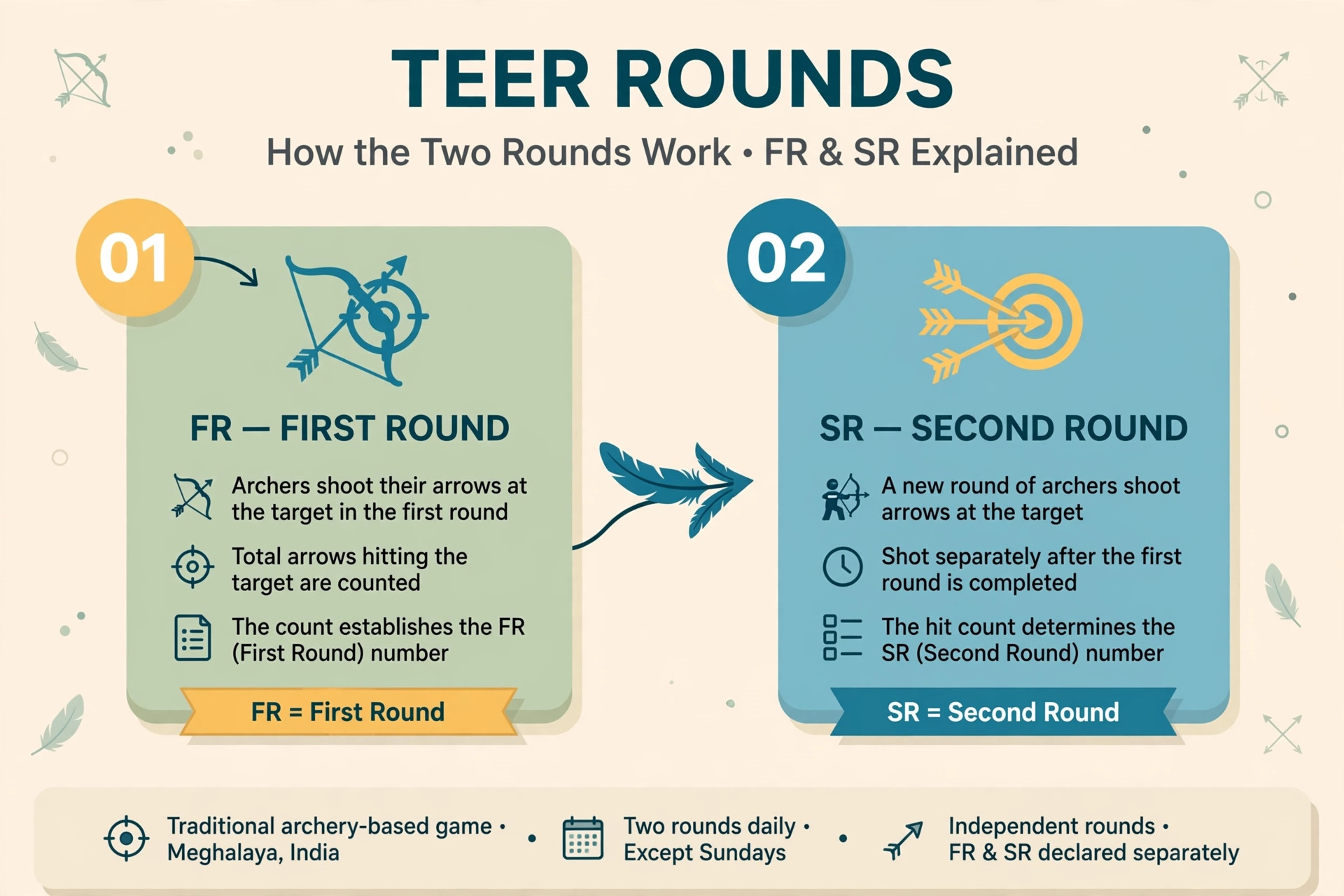
Every result card you see, whether morning or day, shows two values: FR and SR. FR means first round and SR means second round. This is true for all six daytime markets.
In the morning session, the FR numbers appear first through the late morning, followed by the SR numbers. For example, on the Shillong Morning Teer card you might see the FR value filled in while the SR value still shows a dash, which simply means the second round has not been declared yet. The same pattern repeats in the day session in the afternoon: FR first, then SR.
The dash is your friend, not a problem. It is the standard way result websites show that a round is still pending. If you see dashes on every day session card at 11:00 AM, nothing is broken. Those rounds are scheduled for the afternoon, so of course they are still pending. Match the card to the timetable and the dashes will make perfect sense.
Session Timings You Should Memorise
You do not need to memorise exact minutes, but knowing the approximate windows will make checking results much easier. All times below are Indian Standard Time and are the usual declaration hours, which can shift slightly on any given day.
Morning session windows: Shillong Morning Teer usually declares its first round around 10:30 AM and its second round around 11:30 AM. Juwai Morning Teer follows a similar pattern, with rounds around 10:30 AM and 11:30 AM. Khanapara Morning Teer runs a little later, with its first round around 11:00 AM and its second round around 12:00 PM.
Day session windows: Juwai Teer usually starts the afternoon with its first round around 2:30 PM and second round around 3:10 PM. The main Shillong Teer declares its first round around 3:45 PM and its second round around 4:45 PM. Khanapara Teer closes the afternoon with rounds around 4:20 PM and 4:50 PM.
Notice the midday gap again. Nothing is declared between about 12:00 PM and 2:30 PM. If you check during that window, you will see the completed morning results and pending day results side by side, which is exactly how it should look.
A Beginner’s First Day Checking Results
Let us walk through what your first day of checking results could look like, so the routine feels natural.
In the late morning, open the homepage of View Teer Result. Look for the three morning cards: Shillong Morning Teer, Juwai Morning Teer, and Khanapara Morning Teer. By 12:00 PM these cards should show both FR and SR numbers. Note the date on each card to confirm you are reading today’s results.
In the afternoon, come back between 3:00 PM and 5:00 PM. Now look at the three day cards: Shillong Teer, Juwai Teer, and Khanapara Teer. The FR values will fill in first, then the SR values. The main Shillong Teer card is the one most people check at this hour.
In the evening, if you are curious, you can look at the night session cards too. Shillong Night Teer and Night Teer are separate evening sessions, usually declared around 8:30 PM and 9:30 PM. They are not part of the morning teer vs day teer comparison, but they complete the full daily picture.
After one day of this routine, the session system will feel obvious. The key is simply to check each group inside its own time window.
Common Beginner Mistakes and How to Avoid Them
Beginners make the same three mistakes over and over. Here they are, with fixes.
Mistake one is reading the morning card when you wanted the day result. You hear someone talk about the Shillong result, you open the site, and you read the first Shillong card you see, which happens to be Shillong Morning Teer. Fix: always read the full card title. If it says Morning, it is the morning session. The day session card says just Shillong Teer.
Mistake two is checking too early and panicking at the dashes. You open the site at noon, see dashes on all the day cards, and assume the site is broken or the results are missing. Fix: remember the timetable. Day rounds happen in the afternoon, so morning dashes on day cards are normal.
Mistake three is comparing numbers across sessions. You note the Shillong Morning FR number and later compare it with the Shillong Teer FR number, wondering why they are different. Fix: never compare across sessions. Each session is independent, decided by its own archery rounds. Different rounds naturally give different numbers.
Build the habit of checking the title, the time window, and the date on every card, and these mistakes will never trouble you. The teer result list archive page is a good place to practise, because you can see many past days laid out with their session labels.

Morning Teer vs Day Teer – Why Two Sessions Exist
Beginners often wonder why the game is split into sessions at all instead of being played once a day. The answer is practical. Multiple sessions let the organising clubs run the game at different hours, which suits different groups of followers. Morning players get their session before midday, afternoon players get theirs after lunch, and evening players get the night session. It also spreads the archery events through the day, which is easier to organise than one giant event.
From the follower’s side, more sessions simply mean more choice. You can follow the session that fits your schedule, or follow all of them if you enjoy tracking the full day. Nothing about the split makes any session less genuine than another.
How Result Websites Organise the Two Sessions
Once you understand the sessions, the layout of a result website starts to make sense. Most teer portals arrange their homepage as a grid of cards, with one card per market and session. The morning cards are usually grouped together and the day cards are grouped together, often in the same order every day: Shillong Morning, Juwai Morning, Khanapara Morning, then Shillong, Juwai, Khanapara. This fixed order is deliberate. When the layout never changes, your eyes learn where each session lives, and checking becomes a quick glance instead of a search.
Each card typically shows the market name at the top, the FR and SR values in the middle, and the date with the declaration time at the bottom. The declaration time is especially useful for beginners because it proves which session you are reading. A card stamped 11:30 AM can only be a morning result, while a card stamped 4:45 PM can only be a day result. If you ever feel unsure, the time stamp settles it instantly.
Some portals also run dedicated pages for each market, so the morning and day versions of the same centre get their own URLs and their own archives. This separation is helpful when you want to study one session over many days without the other session getting in the way. Whichever layout a site uses, the principle is identical: morning and day are kept visibly apart so that no visitor has to guess.
Frequently Asked Questions
What does morning teer vs day teer mean for a beginner?
It is a comparison between the two daytime sessions of the teer lottery. Morning teer is the late morning session with results declared between about 10:30 AM and 12:00 PM. Day teer is the afternoon session with results declared between about 2:30 PM and 4:50 PM. Both sessions follow the same rules and the same first round and second round format. They are independent, so treat every card as its own result.
Which result should I check if someone just says the Shillong result?
Check the day session card titled Shillong Teer. That is the main afternoon result with rounds around 3:45 PM and 4:45 PM, and it is what most people mean when they say the Shillong result without specifying. The card titled Shillong Morning Teer is a different, earlier result from the morning session.
Are morning teer results less official than day results?
No. Morning teer is a fully official session of the legal Meghalaya lottery for adults aged 18 and above. It is organised by licensed clubs, uses real archery rounds, and its results are just as valid as the day session results. The morning session simply has a smaller audience than the headline afternoon session.
What do I do when a result card shows a dash?
Wait for the session’s time window. A dash means the round has not been declared yet. If you see dashes on day session cards in the morning, that is expected. Check back during the afternoon declaration hours. Result portals like View Teer Result update each card as soon as the official number is confirmed.
How many sessions does teer have in a full day?
On a normal working day there are morning, day, and night sessions. The morning block has three markets, the day block has three markets, and the night block has two to three markets depending on the portal. Each market in each session declares a first round and a second round number.
Can I follow both morning and day sessions?
Yes, and many regular followers do exactly that. Check the morning cards before lunch and the day cards in the afternoon. Just keep the sessions separate in your notes: label every number with its market, its session, and its date so you never mix a morning number with a day number.
Where can I see past results to understand the pattern?
The teer result list page keeps an archive of previous days. Browsing a few past days is the fastest way to see how the morning and day sessions are laid out, because you can observe the full daily pattern without waiting for live declarations.
Conclusion
Morning teer vs day teer is not a complicated rivalry. It is simply the teer day split into two convenient halves: a morning half and an afternoon half. The morning session gives you Shillong Morning, Juwai Morning, and Khanapara Morning results before lunch. The day session gives you Shillong, Juwai, and Khanapara results in the afternoon, including the headline Shillong Teer result that most people follow. Both sessions share the same rules, the same round format, and the same legal standing. Learn the timetable, read the full card title every time, and confirm the date, and you will read teer results like someone who has been following them for years. Bookmark View Teer Result and make it your daily habit.
Teer is a legal lottery game in Meghalaya for adults aged 18 and above only. Please play responsibly.