Introduction: The Question Everyone Asks About Meghalaya Teer
“Is teer legal?” It is the first question almost every newcomer asks about meghalaya teer, and it is a fair one. Teer looks like a lottery, it involves placing money on a number, and gambling laws in India are famously confusing. Rumours travel fast: some people say teer is fully legal, others insist it is a banned gambling racket, and a third group believes it is legal only in Shillong. Most of these claims are half true at best, which is exactly why this guide exists.
Here is the short answer up front. Yes, teer betting is legal in the state of Meghalaya, because the state government licenses, regulates, and taxes it under specific laws. No, it is not legal in most other Indian states, where placing a teer bet can land you on the wrong side of the law. The difference between a legal game and an illegal one comes down to one word: license. This article breaks down the full legal picture in plain language, from the Acts that permit teer, to what a licensed counter looks like, to the lines you must never cross. It is written as a general information guide, not legal advice, but by the end you will understand the teer rules far better than most players do. If you follow the daily game, you can check the daily teer results on our homepage alongside this guide.
Is Meghalaya Teer Legal? The Short Answer
Yes. Meghalaya teer is a legal, state-licensed form of betting on the traditional archery game practiced in the Khasi Hills. The Meghalaya government issues licenses to bookmakers, collects tax on the activity, and regulates how the game is conducted and how tickets are sold. When you place a bet at a licensed teer counter inside Meghalaya, you are participating in a lawful activity recognized by state law.
That statement needs three immediate qualifications, because each one is where people get into trouble. First, the legality is territorial. It applies within Meghalaya, the state whose legislature passed the licensing laws. Second, the legality is conditional. Only licensed operators running the game under the prescribed rules are legal; anyone running teer betting without a license is committing an offence. Third, the legality is personal in a limited sense: this is an adult activity, and the responsible-play position is that only adults aged 18 and above should take part.
The confusion around the question “is teer legal” comes from the fact that all three of these qualifications are invisible to a casual observer. A betting slip looks the same whether it comes from a licensed counter or an illegal one. A website showing teer numbers looks the same whether it is an information portal or an unlicensed online bookmaker. The law, however, sees a sharp difference. The rest of this guide explains where that line is drawn and how to stay on the right side of it.
Why Meghalaya Teer Is Legal Only in Meghalaya
Betting Law in India Is Decided State by State
To understand why teer lottery meghalaya is legal while teer betting in, say, Assam or Bihar is not, you need one piece of background. In India, the power to make laws about betting and gambling sits principally with the individual states, not with the central government in New Delhi. Each state legislature can decide for itself whether to prohibit gambling entirely, to permit certain forms of it, or to license and regulate specific games. This state-by-state arrangement is one of the reasons the Law Commission of India examined the whole subject in its Report No. 276 on the legal framework for gambling and sports betting in India, which discusses how different states have taken very different paths.
The practical result is a patchwork. Some states run their own government lotteries. A small number of states license casinos in defined zones. Most states prohibit most forms of public gambling under their own gambling prevention laws. Meghalaya took yet another path: instead of a blanket ban, it created a licensing system for betting on its traditional archery game. That choice is written into state legislation, and it is binding only within Meghalaya’s borders.
Meghalaya Chose Licensing While Most States Chose Prohibition
Meghalaya’s decision was not an accident or a loophole. The archery game at the heart of teer has been practiced by Khasi communities for generations, long before any betting law existed. Rather than driving the betting underground, the state government brought it into a regulated system: licensed bookmakers, taxed stakes, and rules for how the game is run and how tickets are sold. The meghalaya lottery framework for teer is therefore best understood as the state formalizing a traditional practice instead of criminalizing it.
Other states never passed equivalent laws. In a state without a teer licensing law, there is no such thing as a legal teer counter, because there is no legal category for one to belong to. Betting on teer numbers in such a state falls under that state’s general gambling prohibition. This is the single most misunderstood point in the whole debate. People hear “teer is legal” and assume it is legal everywhere in India. It is not. The license that makes teer legal is a Meghalaya license, issued under Meghalaya law, for activity conducted in Meghalaya.

The Meghalaya Teer Act and Related Laws, Explained in Plain Language
Three state Acts together create the legal foundation for the game. Their names sound intimidating, but each one does a simple job. Here is what each law actually says, in ordinary words.
Section 14A of the Meghalaya Amusements and Betting Tax (Amendment) Act, 1982
This is the cornerstone. The Meghalaya Amusements and Betting Tax (Amendment) Act of 1982 introduced Section 14A, which provides for licensed bookmakers for arrow shooting. The crucial detail is in the definitions: the Act states that “arrow shooting” includes the game of teer. In other words, the legislature explicitly brought teer inside the licensing system rather than leaving it in a grey area. A bookmaker who holds a license under this provision may lawfully accept bets on the archery game, and the state collects tax on the activity. You can read the Act itself on the official state portal in the Meghalaya Amusements and Betting Tax (Amendment) Act, 1982 document, which is the authoritative text.
The Meghalaya Regulation of the Game of Arrow Shooting and the Sale of Teer Tickets Act, 2018
If the 1982 Amendment Act opened the door to licensing, the 2018 Act organized what happens inside the room. The Meghalaya Regulation of the Game of Arrow Shooting and the Sale of Teer Tickets Act, 2018 further regulates both the conduct of the game and the sale of teer tickets. Think of it as the rulebook law: it governs how the game is to be run and how tickets may be sold to the public. Together, the 1982 licensing provision and the 2018 regulatory Act form the two pillars of the current system. When people refer to the “meghalaya teer act” in conversation, they are usually referring to this pair of laws, and most often to the 2018 Act in particular.
The Meghalaya Prevention of Gambling Act, 1970
This is the law that surprises people. Meghalaya does have a gambling prevention law, passed in 1970, which prohibits gambling in the state. The teer system works because that same Act allows the government to exempt notified games from its scope. Teer is such a notified, licensed game. The structure is therefore: gambling is generally prohibited, but the state has used its own exemption power to carve out the licensed archery betting system. This is why unlicensed teer betting remains illegal even inside Meghalaya. The exemption protects the licensed system only; it does not create a free-for-all.
What the Law Commission of India Said in Report No. 276
The Law Commission of India’s Report No. 276 examined the legal framework for gambling and sports betting across the country, and it discusses Meghalaya’s approach as part of that survey. The report’s treatment of the state framework is a useful independent confirmation that teer’s legal status rests on genuine state legislation, not on custom, tolerance, or a loophole. Readers who want the national context can consult the Law Commission of India Report No. 276 on gambling and sports betting, which sets out the Meghalaya position alongside the very different approaches taken by other states.

How Meghalaya Teer Works Under the Rules
Understanding the game format helps you understand what the law is actually regulating. The teer rules describe a simple, transparent contest built on real archery.
The 0 to 99 Number Format
In each session, archers shoot arrows at a target, and officials count how many arrows hit it. Bettors do not bet on individual archers. Instead, each bettor chooses a single number from 0 to 99, which represents the last two digits of the total count of arrows hitting the target. If the count of successful hits ends in, say, the digits shown as “-” (example only, not a real result), then everyone holding that number for the round wins. The format is deliberately simple: one number, two digits, no combinations or systems.
Two Rounds: FR and SR
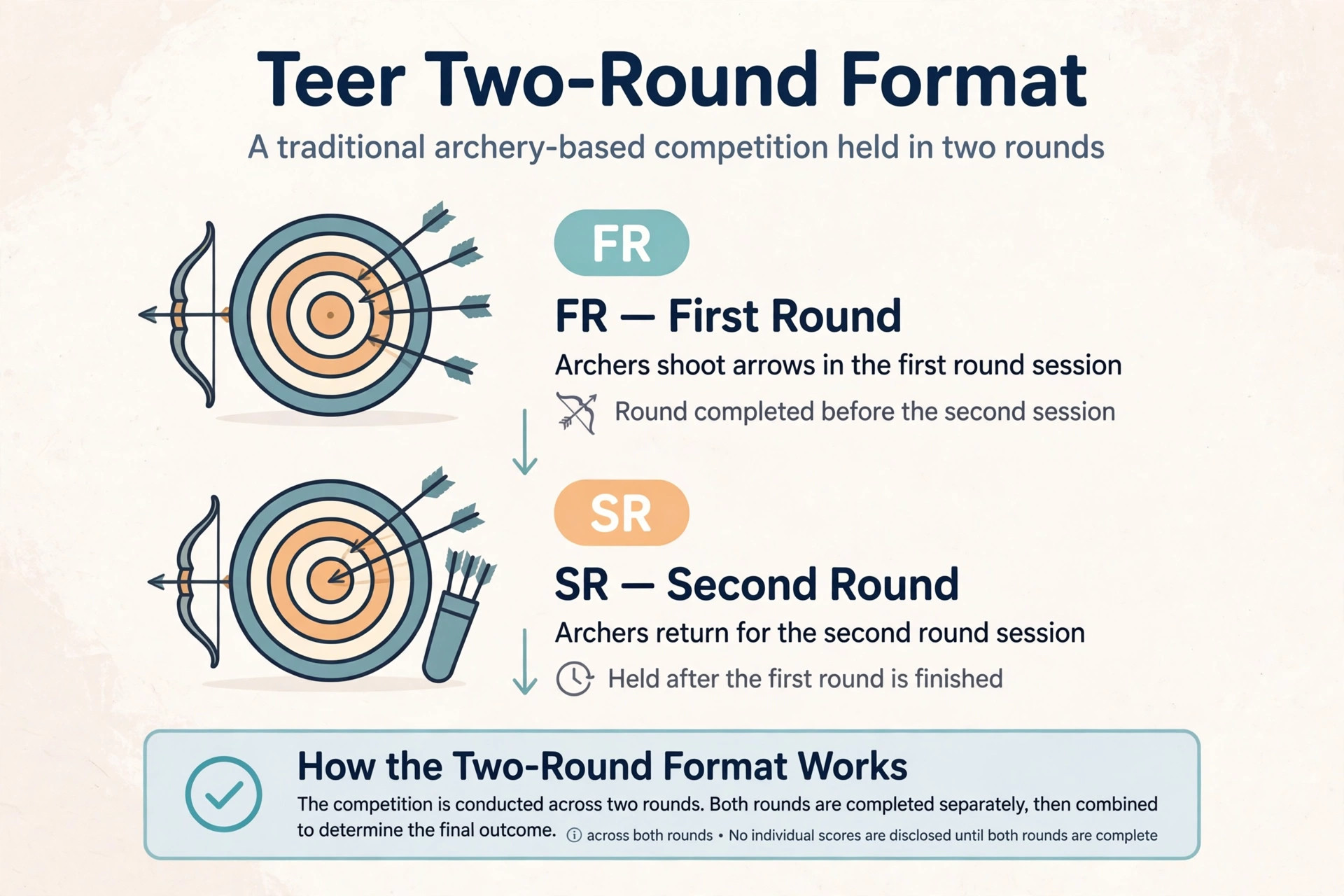
Each teer session is conducted in two rounds. The first round is called FR and the second round is called SR. Bettors may place separate bets on each round, and each round produces its own result based on its own archery shooting. This two-round structure is part of the traditional format and is reflected in how licensed counters sell tickets: tickets are issued per round, and each round is settled independently.
The Khasi Hills Archery Sports Association
The game is conducted under the aegis of the Khasi Hills Archery Sports Association, the body associated with the traditional archery clubs whose shooting sessions form the basis of the betting. This matters legally as well as culturally: the licensed betting is tied to genuine archery events, not to random number generation. The association’s role connects the modern licensed system back to the traditional sport the 1982 Act was written to cover.
What “Licensed” Means for an Ordinary Player
The law speaks of licensed bookmakers, but what does that mean for a person walking up to a counter with a small stake? In practice, “licensed” is the difference between a lawful bet and an unlawful one, and there are visible signs that separate the two.
How to Spot a Legal Teer Counter
A legal teer counter operates openly, at a fixed location, under a license issued by the state authorities. Look for a proper shopfront or stall rather than a whispered transaction in a back room. Licensed counters issue printed tickets for every bet, display their authorization, and operate during the recognized teer hours. They sell tickets for the FR and SR rounds of the established sessions. If a seller cannot show any license, refuses to issue a printed ticket, or operates entirely through secretive channels, treat that as a warning sign. Playing at such a place does not only risk your money; it may mean participating in an unlicensed operation.
What Your Teer Ticket Should Show
A proper teer ticket is your proof of a legal bet. It should clearly show the number you chose (from 0 to 99), the round (FR or SR), the date, the stake amount, and identification of the issuing counter. Keep your ticket safe until the round is settled, because it is the document you will need to claim any winnings. Licensed counters settle prizes according to the fixed terms they operate under. If a seller offers only verbal bets with no ticket, you have no proof of your wager and no legal standing if a dispute arises. The ticket is not just a receipt; it is the boundary between the regulated system and the shadows.

What Is NOT Legal: Lines You Must Not Cross
This section is the myth-busting core of the guide. Knowing that meghalaya teer is legal is only half the knowledge you need. The other half is knowing exactly which activities the law does not protect.
Unlicensed Betting Operations
The most important line is also the simplest: running or patronizing teer betting without a license is illegal, even inside Meghalaya. The 1970 Prevention of Gambling Act still prohibits gambling generally; the exemption covers only the licensed system created by the 1982 and 2018 Acts. An unlicensed operator who takes teer bets is committing an offence, and the entire operation, from the person collecting stakes to anyone organizing the racket, sits outside the law. Players should understand that “teer is legal” never means “all teer betting is legal.” It means licensed teer betting is legal.
Buying Teer Tickets Outside Meghalaya
A ticket bought outside Meghalaya is not covered by Meghalaya’s licensing system. Remember that the license is territorial: it authorizes activity within the state. Someone selling “teer tickets” in a state that has no teer licensing law is operating an unlicensed betting business under that state’s law, regardless of what they claim about Meghalaya. This is one of the most common traps. Travellers and migrants are sometimes offered teer betting in cities far from Meghalaya on the argument that “teer is legal in India.” It is not legal in India as a whole. It is legal in Meghalaya, under Meghalaya licenses, at Meghalaya counters.
Online Operators Without a License
The internet has created a grey zone full of confident claims. Websites and messaging groups that accept teer bets online are legal only if they hold the proper authorization to operate as licensed bookmakers. Most do not. A results information portal is one thing; a site that takes your money on teer numbers is acting as a bookmaker, and bookmaking without a license is unlawful. Be especially cautious of operators who accept payments through personal wallets, refuse to identify their licensing, or are based outside Meghalaya while taking bets from anywhere. Viewing published results for information is entirely different from placing a bet through an unlicensed online operator, and the law treats the two very differently.
Teer Prize Rules in Plain Words
Questions about the teer prize come up constantly, so here is how prizes work in general terms. When you win a round, the licensed counter pays you a fixed multiple of your stake, according to the prize terms set for that counter’s licensed operation. The multiple is fixed and known in advance; it does not change from day to day or depend on how many people played. Your ticket is your claim document: present the winning ticket for the correct round and date, and the counter settles the prize.
Two cautions belong here. First, never accept a specific multiplier figure from rumour or from an unofficial website as fact; the authoritative terms are those of the licensed counter where you placed the bet. Second, prize claims have practical time limits set by the operator, so check your ticket against the declared result promptly and claim within the counter’s stated window. If you want to follow results day by day, the complete teer result list keeps the declared numbers in one place for reference.
Penalties for Illegal Teer Operation
The licensing system has teeth. Because unlicensed teer betting falls under the general gambling prohibition, those who run illegal operations face the penalties the Acts prescribe, which can include fines and imprisonment. The exact consequences depend on the specific offence charged, whether it is operating without a license, organizing an illegal betting racket, or related violations, and on how the courts apply the law to the facts of each case.
Players should note the practical risks beyond the courtroom. Money placed with an unlicensed operator has no legal protection: if the operator disappears or refuses to pay a winning bet, there is no licensed counter to complain to and no ticket worth the paper it is printed on. Winnings from illegal operations can also attract the attention of authorities for the operator and create complications for everyone involved. The licensed system exists precisely to remove these risks, which is why staying inside it is both the lawful and the sensible choice.
Frequently Asked Questions About Meghalaya Teer Law
Is teer legal in India?
Teer is legal in Meghalaya, where the state government licenses and regulates betting on the traditional archery game under the 1982 Amendment Act (Section 14A), the 2018 Regulation Act, and the exemption mechanism of the 1970 Prevention of Gambling Act. It is not legal across India as a whole. In states that have no teer licensing law, teer betting falls under the general gambling prohibition of that state. The common slogan “teer is legal” is therefore accurate only with the words “in Meghalaya” attached to it.
Can I play teer if I live outside Meghalaya?
You can lawfully participate only through the licensed system, which operates within Meghalaya. Buying a so-called teer ticket from a seller in a state with no licensing framework is not protected by Meghalaya’s laws, because those laws authorize activity inside Meghalaya. If you are visiting the state, play only at openly licensed counters that issue printed tickets. If someone offers you teer betting where you live outside Meghalaya, treat the offer with great caution, since no license issued by Meghalaya can legalize betting conducted elsewhere.
What is the Meghalaya Teer Act?
When people say the “meghalaya teer act,” they usually mean the Meghalaya Regulation of the Game of Arrow Shooting and the Sale of Teer Tickets Act, 2018, which regulates how the game is conducted and how tickets are sold. The wider legal foundation also includes Section 14A of the Meghalaya Amusements and Betting Tax (Amendment) Act, 1982, which created the licensing system for bookmakers and defined “arrow shooting” to include teer, plus the Meghalaya Prevention of Gambling Act, 1970, whose exemption power makes the licensed system possible.
Is online teer legal?
Viewing teer results on an information website is not betting and raises no legal issue. Actually placing a bet online is a different matter: the online operator is acting as a bookmaker and needs proper licensing to do so lawfully. Most websites and messaging groups that accept teer stakes online hold no such license. Before trusting any online operator with your money, you would need to verify that it is a genuinely licensed bookmaker, and the burden of that proof is on the operator, not on you.
What happens if I buy a ticket from an unlicensed seller?
At minimum, you lose the protections of the licensed system. An unlicensed seller issues tickets that no authority recognizes, so if you win and the seller refuses to pay, you have no legal claim. Beyond the financial risk, participating in unlicensed betting means taking part in an activity the law prohibits, since the gambling exemption covers only licensed operations. The safe course is simple: buy only from openly licensed counters that issue proper printed tickets.
Is teer a lottery or a sport?
It is both, in a sense, and the law reflects that duality. The underlying event is a genuine traditional sport: archers shooting at a target under the aegis of the Khasi Hills Archery Sports Association. The betting layer built on top of it functions like a lottery, with players choosing numbers from 0 to 99. The legislation treats it as licensed betting on arrow shooting rather than as a conventional paper lottery, which is why the Acts speak of bookmakers, arrow shooting, and teer tickets rather than lottery draws.
Conclusion
The myth-busting summary is straightforward. Meghalaya teer is legal because Meghalaya’s elected legislature chose to license it, tax it, and regulate it through three specific Acts, and the Law Commission of India has noted this framework in its national survey of gambling law. It is legal only in Meghalaya, only through licensed operators, and only in the form the law prescribes: real archery, licensed counters, printed tickets, two daily rounds. Everything outside that frame, from unlicensed street operators to out-of-state sellers to shady online bookmakers, is not protected by the law no matter how confidently it claims otherwise.
If you take one rule away from this guide, make it this: always verify the license behind the counter before you verify anything else. To learn more about who we are and how this site works, visit our about us page, and if you have questions about the information published here, you can reach us through our contact us page.
Please play responsibly. Teer is a legal lottery in Meghalaya for adults aged 18 and above only. Never bet money you cannot afford to lose, and treat the game as entertainment, not as a source of income.